
Our story
It started in 2022 with hundreds of conversations and tests on how to capture the complex, multifaceted topic of flexible energy and distributed demand response, and create a solution that steers that flexibility to meet growing demand response needs.
Russia’s energy aggression against Europe made the need more urgent. This was no longer just about the green energy transition: it was also about the resilience of electricity systems and the role buildings could play in balancing them.
That work became Energy Coop, Truman Data’s AI-driven, battery-first virtual power plant. It is a platform that enables energy sellers and energy users to trade demand response from the end-customer-owned built environment with each other. The buildings, batteries and other energy assets remain under the customer’s control.
The world is changing – for good and for better
Electrification of societies increases the global consumption of electricity, which is increasingly produced by wind and solar power. At the same time, societies are building battery storage, while people are charging their growing number of electric vehicles and producing their own electricity locally, outside the grid operator’s control. This megatrend poses a significant challenge for national grid operators, who must keep the grids in balance at all times.
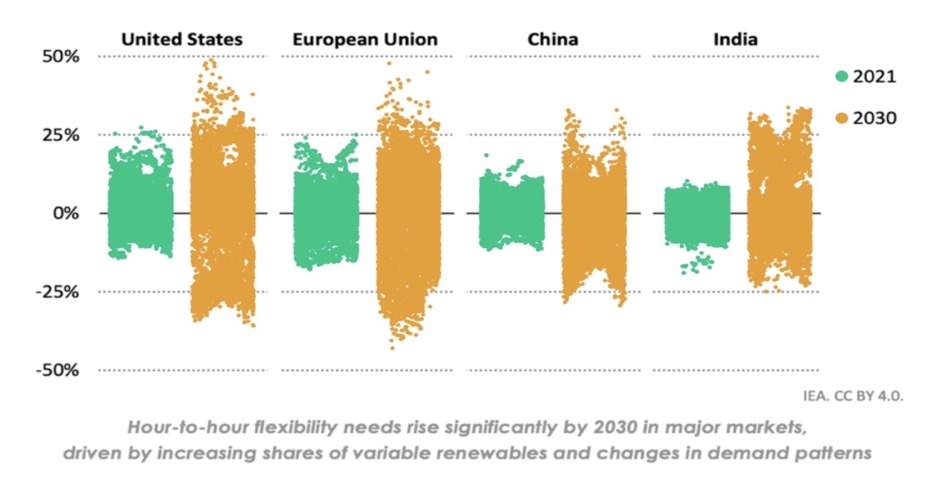
Electricity markets rely on forecasts of consumption and production, including day-ahead schedules at 15-minute intervals. As production becomes more weather-dependent and consumption patterns change, the need for demand response grows. According to the International Energy Agency (IEA), global demand response capacity needs to increase tenfold, with buildings — already consuming a third of global electricity — playing a major role. To put the scale in perspective, the required demand response capacity from buildings (260 GW) is comparable to Germany’s total electricity generation capacity1. Existing market mechanisms, mainly designed for energy companies, do not make it easy for building owners to participate.
VTT’s research had reached the same conclusion. Electricity markets rest on estimates and models of consumption and production, and the uncertainty is growing at both ends, with larger fluctuations and peaks in electricity prices. When we, along with the VTT team, presented the Fleximar marketplace and the GLocalFlex project in January 2024, the conclusion was clear: flexibility is needed more than ever.
1 Germany is the sixth largest consumer of energy in the world. The country also had the largest national market of electricity in Europe.
Energy Coop enables the parties to trade
Energy Coop is not an exchange. It is the platform that enables the parties to trade: building owners offer demand response from their properties and BESS energy assets, while energy users and balance responsible parties buy the flexibility they need. The customer sets the price terms, operating requirements and environmental targets.
By integrating an API and a virtual IoT bridge with existing energy-saving and building automation systems, Energy Coop brings the property’s energy assets together as a single power and flexibility reserve. This connects energy optimisation to a new revenue stream from flexibility trading, rather than treating lower energy bills as the only benefit.
The intended market is the EU’s EUR 90–120B flexibility market, alongside existing balancing and intraday markets.
Sellers
End-customer-owned buildings and BESS energy assets
Funds, trusts, cities and building portfolio owners
The Energy Coop platform
Enables demand response trading between the parties
Buyers
Energy users and balance responsible energy companies with imbalance
Including wind, solar power and battery storage operators
Truman Data’s business model is in trading. Its Energy Coop platform enables flexibility transactions between end customers and balance responsible parties, charging a 20% commission on the transaction. The aim is to obtain the best price level for flexibility from the customer’s real estate and BESS energy assets — a price level the end customer could not otherwise reach.
For property owners, this also supports the transition from ‘brown’ to ‘green’ buildings, improving ESG performance, supporting LEED verification and strengthening property value.
Truman Data’s ForeCoop IoT Bridge service for building portfolio owners
ForeCoop IoT bridge serves as a (physical or virtual) terminal in the buildings to forecast the energy consumption, local energy production and detect the demand response opportunities for trading. ForeCoop can also activate the events and verify the transactions. It works with existing EMS systems or as a standalone solution.
ForeCoop provides the connection between the building and the trading enabled by Energy Coop. Forecasting, activation and verification help property owners participate despite the high minimum thresholds and complex reporting requirements that would otherwise put these revenue streams out of reach.
1. Buildings
Customer-owned commercial and industrial buildings, their BESS and existing energy systems.
2. ForeCoop
Forecasts available flexibility, activates agreed events and verifies delivery.
3. Trading
Energy Coop enables the parties to trade demand response, connecting the built environment to flexibility and grid balancing reserve markets.
From VTT research to verified pilots
The platform builds on technologies developed and tested with VTT. To get here, we worked closely with VTT, particularly alongside the VTT-led EU GLocalFlex program.
GLocalFlex (Global & Local energy flexibility marketplace to demonstrate grid balancing mechanisms) is a Horizon Europe project that started on 1 January 2023 and runs for four years. Its 19 partners and 5 associate partners are creating one easy-to-access flexibility marketplace for consumers, companies and distribution system operators (DSOs), with six pilot sites in Finland, France, Spain, Switzerland, the Czech Republic and Germany.
The Fleximar research foundation
Fleximar, the marketplace technology developed at VTT, was created because there were no feasible marketplaces for real-time trading of electricity demand and response, the existing markets could not trade small batches of energy cost-efficiently, and location was not used as an asset. Its goals were open-source tools, simple trading rules, ledger-based money transfer, an open market for buyers and sellers, and near real-time operation. Its control approach asks three questions about any system: how it behaves if no action is taken, what its minimum and maximum states are, and which control changes are needed to reach those states safely. Machine learning and AI provide the answers.
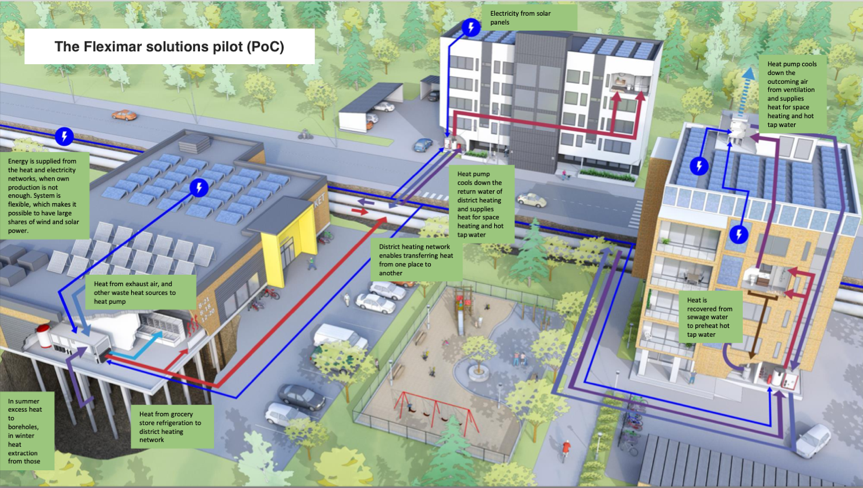
Proof of concept (PoC) No. 1: Fleximar pilot at the S-Arina supermarket and a collection of buildings in Oulu, Finland
- The pilot was part of Making City, an EU Lighthouse project worth EUR 22 million, with the Oulu site worth EUR 6 million.
- The project combined zero emissions, efficient use of waste heat, local energy production and advanced heat pump solutions.
- Sector coupling covered over 200 apartments in four buildings, a school and three grocery stores, one of which, with 16,000 m² of floor space, has become the most energy-efficient grocery store in the world.
- VTT developed new technologies and control systems for heating and cooling together with the companies involved.
Proof of concept (PoC) No. 2: a Finnish municipal building portfolio
- Fingrid, Finland’s national grid operator (TSO), verified and approved the solution in selected reserve markets (FCR-N and FCR-D).
- We installed edge devices that connect different buildings in a Finnish municipal portfolio.
- Installation takes one to four hours, depending on the building.
- Millions of data points were collected and verified.
The next stage: a customer-first, BESS-first platform
At Truman Data, we commercialise technology developed at VTT*, further developed into the Energy Coop platform. We have developed IPR technology worth nearly EUR 3 million and market-tested the technologies separately. The platform has now reached its third development stage: merging these capabilities, including BESS, and preparing for commercial market entry in 2027.
Energy Coop is a decentralised, edge-based energy flexibility solution that tracks the energy-use assets wherever it is connected, offered as a platform service to customers in the built environment.
Put simply, Energy Coop is our AI-driven, battery-first (BESS-first) virtual power plant. It optimises all energy use in any building, as well as the operation of the batteries in those buildings, and combines these different energy assets of a property into a single power and flexibility reserve that can be traded on the markets and is as profitable as possible for the customer.
We do not sell or own our customers’ equipment, so the BESS that will eventually enter the buildings to tackle rising energy costs, and the added value they generate, always remain under the customer’s control, like any energy asset aggregated from the property owners’ buildings.
Before the planned commercial market entry, we are inviting the next customers in Finland to participate as pilot partners and assess the opportunity in their own building portfolios.
* VTT (Technical Research Centre of Finland) is a forerunner in research, development and innovation, and one of Europe’s leading research organisations developing cutting-edge technologies.
Become a pilot partner
A new business model is now in the battery market, and it starts with the customer.
The Energy Coop platform, Truman Data's AI-driven virtual power plant, is now available to its next customers in Finland.